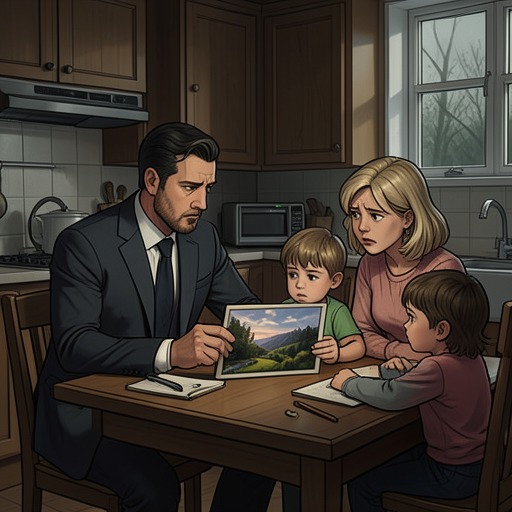
Family as both support and vulnerability
Three SecondsFamily is both Piet Hoffmann’s strongest source of steadiness and the point at which his undercover life becomes most dangerous. Zofia, Hugo, and Rasmus draw him back toward ordinary pleasures and responsibilities, yet the secrecy required by his work makes their home life vulnerable to lies, sudden absences, and risks he had promised himself they would never share.
Family as an Anchor
In traffic, Hoffmann tries to manage the strain of a stalled afternoon by recalling particular signs of family life: the softness of Zofia’s face, Hugo riding his bicycle alone, and Rasmus’s hair spattered with food. The memories do not erase his thoughts about the fatal deal in Västmannagatan, but they give him somewhere else to direct his attention. His family is not an abstract reason to keep going; it is a collection of intimate, ordinary details that interrupts the mental return to violence and danger.
That same grounding appears at Hagtornsgården preschool. Before entering, Hoffmann pauses to listen to the children and allows himself to linger in what he considers the best moment of the day. He remembers to check that he has removed his holster before going inside. The gesture makes the boundary between his work and family life concrete: he cannot simply carry the signs of his other identity through the door and into the children’s space. Once inside, he sits among the small shoes and jackets, helps Rasmus put on his coat and outdoor shoes, and secures the children in their car seats. Care is expressed through practical attention, even while the day’s danger remains close.
At home, the children’s play briefly restores a sense of ease. After stopping the car, Hoffmann releases the seat belts and watches Hugo and Rasmus run across the grass and crawl through a hedge into the neighbors’ garden, where other children and dogs are. Their energy makes life seem simple for a moment. The scene is not a solution to his predicament, but it shows what his family gives him: a vivid, immediate world whose value does not depend on his work or his criminal cover.
The Exposure of Ordinary Life to Work
The pressure comes from the fact that home and undercover work occupy the same day and sometimes the same physical space. In one compressed inventory, amphetamine capsules, properly secured child seats, and shoes bearing traces from a fatal incident belong to Hoffmann’s working life. He does not want to recognize them as parts of a single day. The juxtaposition makes the vulnerability structural: family routines continue beside the material consequences of his covert activity, although he would prefer to keep the two worlds separate.
Even the preschool pickup requires him to monitor what he brings into the children’s environment. Later, after collecting the boys, he remembers that the shoes he wore to the fatal deal must be disposed of before he can put them back into ordinary domestic circulation. He starts the boiler manually and burns them in the cellar. The act is practical, but it also marks the effort required to keep evidence of his work from crossing into the house. His family offers a refuge from the operation only because he continually tries to manage that boundary.
His professional obligations can also interrupt shared time without warning. Hoffmann tells Zofia that an emergency meeting requires him to travel to Warsaw that evening, though he expects to return the following night. She had looked forward to spending the evening together and is disappointed, even as she accepts his explanation. Their embrace carries his wish to hold on to the intimacy of home, while the journey immediately reasserts the demands of his concealed work. The family is a support, but it is also the part of life that his absences and cover stories can unsettle.
Secrecy, Trust, and the Broken Promise
Hoffmann’s commitment to protect his family begins as a rule he sets for himself when recruited: he will never put anyone he loves in danger. He remembers an earlier occasion when senior figures visited his home and Zofia welcomed them for coffee without knowing who they were or what their visit meant. He explained them away as clients. She believed him, and the incident demonstrated how easily the ordinary hospitality of home could be incorporated into a false account of his working life.
When the danger around him intensifies, that boundary fails in a more immediate way. After leaving a safe flat amid the pressures of the shooting and his breakthrough involving Wojtek, Hoffmann is told that the two boys have fevers and need to be collected. He takes them home, gives them medicine, and keeps watch over them. But the demands of the investigation do not stop because his children are ill. He brings them with him while attending to matters connected to the case, and feels shame at having placed them in a situation where they should not have been. The episode turns his protective intention into a contradiction: the work he pursues for reasons bound up with survival has made his children present where he never intended them to be.
The contradiction is sharpened by his relationship with Zofia. He is accustomed to assessing a lie for plausibility before he has fully acknowledged that he is about to tell it. This time he feels the lie as a burden because it touches the trust on which their life together rests. He watches her washing dishes in the home they share and recognizes that she trusts him, just as he trusts her. His sense of strength and purpose is bound up with that mutual trust; imagining its withdrawal makes him feel that he would collapse. Yet preserving the relationship through concealment also damages the honesty that gives the trust its meaning.
Hoffmann finally understands that his vow has become another story he tells himself. He had despised people who deceived themselves, but now recognizes that he has crossed the moral boundary he claimed would define him: he has used his family as part of a lie and drawn Zofia and the boys into its consequences. The realization makes family more than a source of comfort. It is also the measure by which he judges his conduct, and the evidence that his self-image as a protector cannot survive unchanged.
Home and Confinement
The narrative’s contrast between family life and prison makes separation another measure of what home provides. On entering Aspsås prison, Hoffmann confronts the physical reality of a place he had previously studied from outside and prepared for through information about its people and routines. After ten days, he has spent twenty-three hours a day in a small cell, with no visitors, newspapers, television, or radio. The account emphasizes the imposed narrowing of time and contact. Against that enclosure, the family routines of collecting children, fastening shoes, and sharing an embrace represent a life organized around presence and reciprocal care.
Once assigned to a unit, Hoffmann studies its routines and positions himself where the returning prisoners will see that he is not hiding or waiting for permission to belong. The unit is to become his home, but the word names an imposed place rather than the chosen household he shares with Zofia and the boys. Later, when exposure threatens him, he is escorted to voluntary isolation, where movement is restricted to a separate unit and contact with prisoners from other sections is prevented. These prison arrangements make his vulnerability legible in institutional terms: his safety depends on where officials place him and who can reach him, not on the protections of family life.
The family therefore operates in two directions throughout Hoffmann’s story. Remembered gestures and domestic responsibilities help keep him oriented toward a life beyond his assumed identity; at the same time, secrecy, travel, and dangerous decisions threaten to make that life bear the costs of his work. His care for Zofia, Hugo, and Rasmus is genuine, but care alone cannot guarantee their safety when he breaks his own rule and lets the operation enter the home. The tension gives family its decisive significance: it is both the reason he seeks to preserve an ordinary life and the human stake that makes concealment morally costly.